
Ejection systems in injection molding are crucial for producing high-quality parts. They safely eject the molded parts from the cavity.
A well-designed ejection system prevents part deformation by removing the part from the cavity without damage. It’s thus crucial to choose the right ejection system in injection molding. In this article, we discuss the primary functions and various types of ejection systems.
An ejection system is the last step in the injection molding cycle. When the hot resin is injected into the mold, it is allowed to cool and solidify. An ejection system in injection molding ejects the solidified plastic part from the mold cavity.
Designers optimize its performance by choosing the correct size and location. They should be placed in the part’s rigid areas, and designers must incorporate sufficient ejectors to evenly distribute the load.

The first function of the ejection system is to release the part efficiently from the mold. Ejection systems completely eject the part through the applied force.
Ejection systems enable design flexibility. They facilitate manufacturers to create design elements through various components, such as pins, sleeves, plates, etc.
Some ejection components, such as pins and ejector sleeves, have smaller gaps that further provide more venting. They break vacuum seals that are formed during cooling, and these venting channels facilitate air removal, which reduces defects.
An ejection system distributes the ejection force evenly, which further controls the stress on the part. It applies uniform force to remove the part so that no distortion is caused. This aspect enables manufacturers to preserve dimensional accuracy during demolding. It also minimizes surface marks on the finished parts to preserve the aesthetics and functional quality.
Ejection systems release the part through controlled retraction mechanisms. It thus prevents damage to the mold components.
Ejection systems in injection molding enable manufacturers to automate the cycle. It reduces the manual operation by syncing the mold’s opening and closing. It also supports high-volume production runs through reliable cycle repetition.
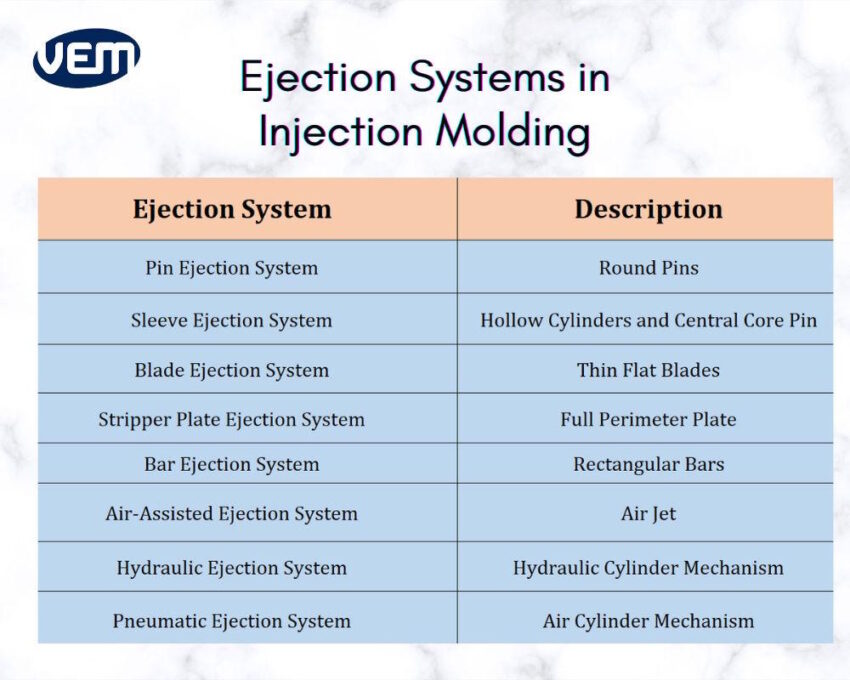
A pin ejection system is a simple, cost-effective, and one of the most common types of ejection systems in injection molding.
The system employs small, round ejector pins. These pins eject the part from the mold. They are suitable for small to medium-sized parts and are compatible with various part types and most geometries. These pins tend to leave circular marks on the part, which is why it’s crucial to place the pins in non-visible areas to prevent aesthetic defects. You can read more about Ejector Pins here.
A sleeve ejection system incorporates hollow cylinders. It’s perfect for shapes that incorporate either circular holes or tubular shapes.
Ejection sleeves distribute pressure across circular features. They surround the mold core and push the part from its perimeter during ejection. It’s ideal for delicate cylindrical parts.
Ejection sleeves are composed of 2 components: A hollow sleeve and a smaller solid core pin that typically forms a part feature and extends past the sleeve in the mold’s unactuated state.
A blade ejection system incorporates thin, flat blades. Manufacturers primarily use them to push out thin-walled parts or parts with large, flat surfaces. It can distribute force over a larger area.
The stripper plate ejection system is apt for large parts or complex geometries that require additional support across the entire edge. It distributes the ejection force. You should note that the mold design is more complex.
A bar ejection system incorporates rectangular bars and is employed for long and narrow parts. They are also popularly employed for parts that have ribs or rectangular features.
Ejection bars combine multiple pins topped by a flat bar that evenly distributes force.
An air-assisted ejection system applies compressed air to separate lightweight or delicate parts. It’s suitable for small and intricate components. These types of systems avoid physical marks.
A hydraulic system incorporates hydraulic cylinders and is apt for heavy parts ejection. Its key advantage is that it can achieve high sheer power.
A pneumatic ejection system employs compressed air cylinders. It’s gentle on delicate parts and is apt for parts that require good pressure control and ejection timing.
It is crucial to choose the correct ejection system as it directly influences the part quality and production efficiency. You should consider the following factors:

The part design analysis is the first aspect. It is important to pay attention to the surface and part features as part geometries directly impact the type of ejection system in injection molding. Pin systems are more suitable for simple geometries, whereas complex geometries require lifters, sleeves, or a stripper plate system to effectively release the part.
The next key factor is the material consideration, and you must choose an ejection system that is particularly apt for the resin properties, as they determine the ejection force.
High-shrinkage materials require higher ejection force, as they adhere strongly to mold surfaces than the lower shrinkage materials. You should note that if the material is soft, the ejection force must be lower to avoid damage.
Production requirements are the next key aspect for selecting the correct ejection system, as they affect its durability requirements. If the project volumes are high, then the ejection system must be fast and robust so the system can withstand thousands of cycles without wear and tear.
The correct ejection system should give you a good cost-benefit analysis such that the initial setup expenses outweigh its lifetime cost.
It also depends on the available budget. Advanced systems, such as stripper plates have a higher investment than pins.
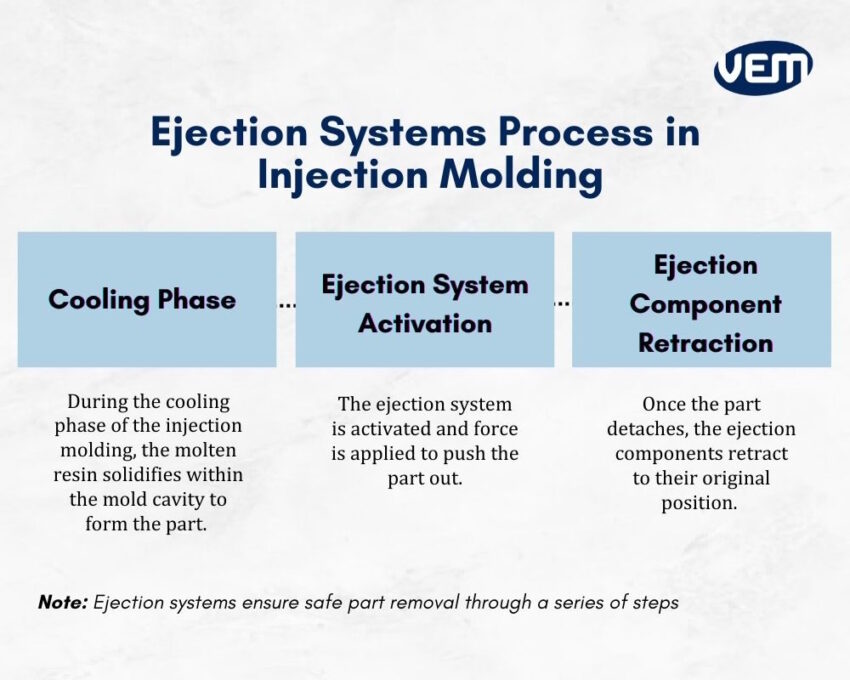
Ejection systems ensure safe part removal through a series of steps. Let’s understand these steps in the injection molding cycle:
During the cooling phase of the injection molding, the molten resin solidifies within the mold cavity. Once the solidified part is formed, the two halves of the mold separate to open the mold.
During this phase, the ejection system is activated. The force is applied through components such as pins or plates, to push the part out.
Once the part detaches, the ejection components retract to their original position. The mold now closes for the next injection molding cycle to begin.
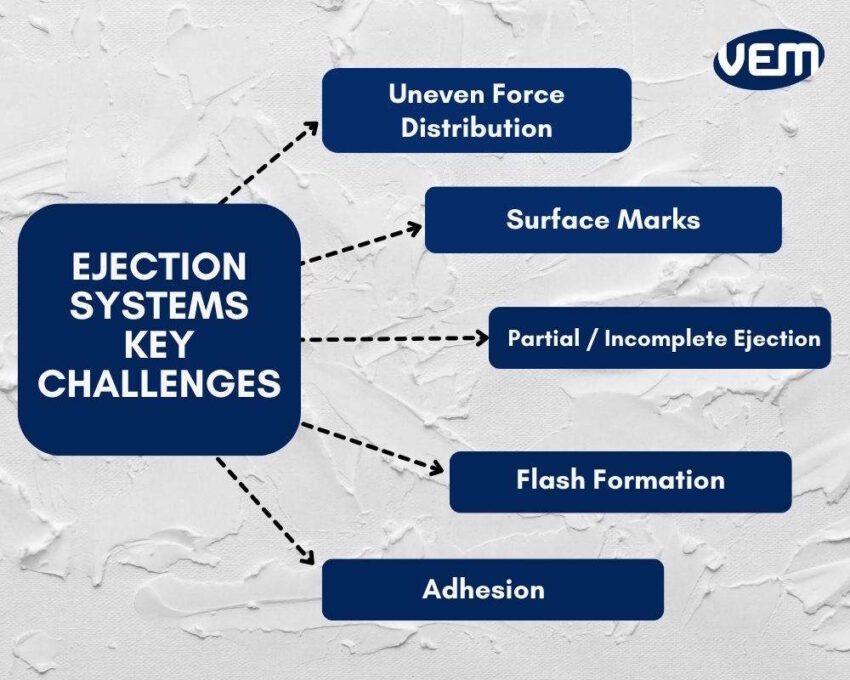
The first key challenge is the uneven force distribution due to misplaced pins or blades, which often leads to part warping.
Surface marks affect part aesthetics. They typically occur when ejection systems are in contact with the part’s visible areas.
Adhesion primarily occurs due to insufficient venting or premature ejection. You can correct this by adding air channels to break vacuum seals.
This is typically caused due to misalignment or low force. This can be corrected by ensuring the correct alignment of the ejection system.
If sealing isn’t right, gaps are formed during ejection. This can further lead to flash formation.
Ejection systems in injection molding offer design flexibility and improve production quality. It has a large impact on part quality and manufacturing cycles. It is crucial to choose the correct type of ejection system for your project.
VEM Tooling has extensive experience of over 20 years in tool building and producing high-quality parts. We can guide you with the optimization of ejection systems and other injection molding solutions.